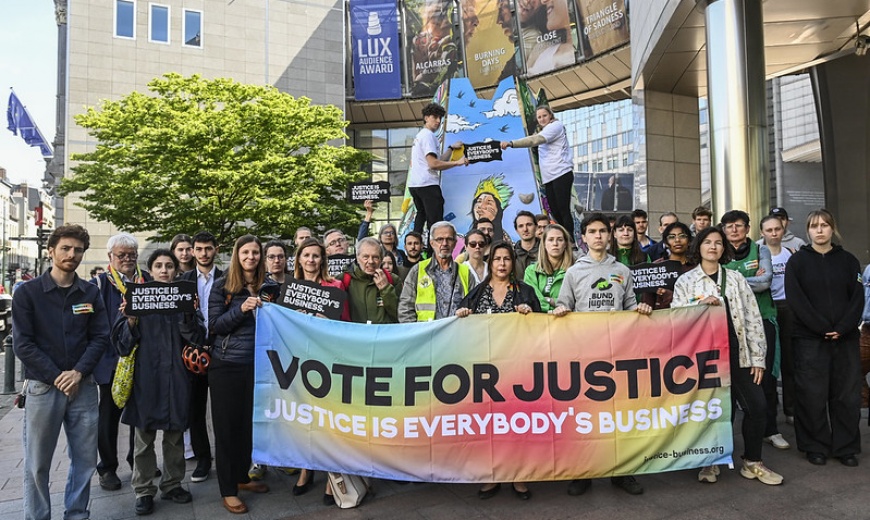
The Clean Clothes Campaign and Novi sindikat welcome the European Parliament’s report on the Corporate Sustainability Due Diligence Directive (CSDDD), which passed with 366 votes in favor, 225 against, and 38 abstentions. This report marks a significant step toward holding companies legally accountable for workers’ rights throughout their entire supply chains.
Just one month ago, we marked the 10th anniversary of the Rana Plaza collapse in Bangladesh, where at least 1,138 textile workers lost their lives and thousands more were injured. This horrific tragedy destroyed the lives of thousands of workers and their families.
The disaster drew worldwide attention to the systemic exploitation within the garment industry and highlighted the urgent need for mandatory corporate responsibility. Despite promises of change, the voluntary commitments made by some companies have proven insufficient to significantly improve the lives of textile workers.
For years, workers, citizens, and civil society organizations around the globe have demanded legislation that protects people, communities, and the environment, ensuring that corporations are held liable for the negative consequences of their operations.
The text of the report voted on yesterday demonstrates the European Parliament’s resolve to fight for human rights and environmental protection worldwide. Members of the European Parliament (MEPs) have improved upon the European Commission’s initial proposal and the Council’s subsequent general approach in several key areas.
The current version of the text requires a large number of companies to conduct an in-depth analysis of their supply chains and business associates, in accordance with United Nations (UN) and OECD international standards. During this due diligence process, companies must address a broader range of human and labor rights, including those defined by the International Labour Organization (ILO) regarding occupational health and safety, as well as violence and harassment in the workplace, and the right to a living wage.
Companies will be required to assess how their business models and pricing practices might cause harm to workers. This makes it possible to prove that predatory purchasing practices—such as setting prices too low for orders—directly result in widespread rights violations. Furthermore, the directive seeks to remove certain procedural barriers currently faced by victims of corporate abuse when seeking justice.
Despite these advancements, we regret that the Parliament has not yet incorporated value chain mapping or a mandatory transparency obligation as part of the due diligence process. A comprehensive risk identification process must include the mapping and disclosure of individual suppliers to pinpoint exactly where production takes place.
Additionally, we remain concerned by the following issues. Despite countless reports showing that voluntary social audits often fail and are frequently used to mask violations rather than fix them, the report still places too much emphasis on these initiatives.
Furthermore, the text currently lacks a full transfer of the burden of proof onto the companies. This absence of a mandatory transfer of responsibility remains a significant hurdle for affected workers seeking justice and accountability.
Millions of garment workers worldwide continue to face daily attacks on their freedom of association, health and safety, and right to a living wage. It is high time the European Union changes how corporations operate within its borders.
The next step following this vote is the trilogue negotiations between the three EU institutions (Parliament, Commission, and Council). We call on the Commission and the Council to follow the Parliament’s example and incorporate these key improvements into the final legislative text.